Consulting Service
EBSD Data Analysis & MTEX Consulting
Your EBSD maps hold quantitative answers about texture, grain structure, and deformation — if the analysis is done right. Scripted MTEX and Python pipelines, from measurement review to publication figures to DAMASK-ready simulation inputs.
Who this is for
The PhD student with gigabytes of EBSD maps and a vendor software licence that answers none of their actual questions. The group that measured beautiful data and now needs publication-quality pole figures and ODFs with a methods section that survives review. The simulation team that needs real microstructures turned into CPFEM inputs without the conversion quietly corrupting the physics.
EBSD data is expensive to measure and easy to analyse badly. The gap between "we have maps" and "we have quantitative, defensible microstructure results" is exactly what this service closes.
What an engagement covers
Why me
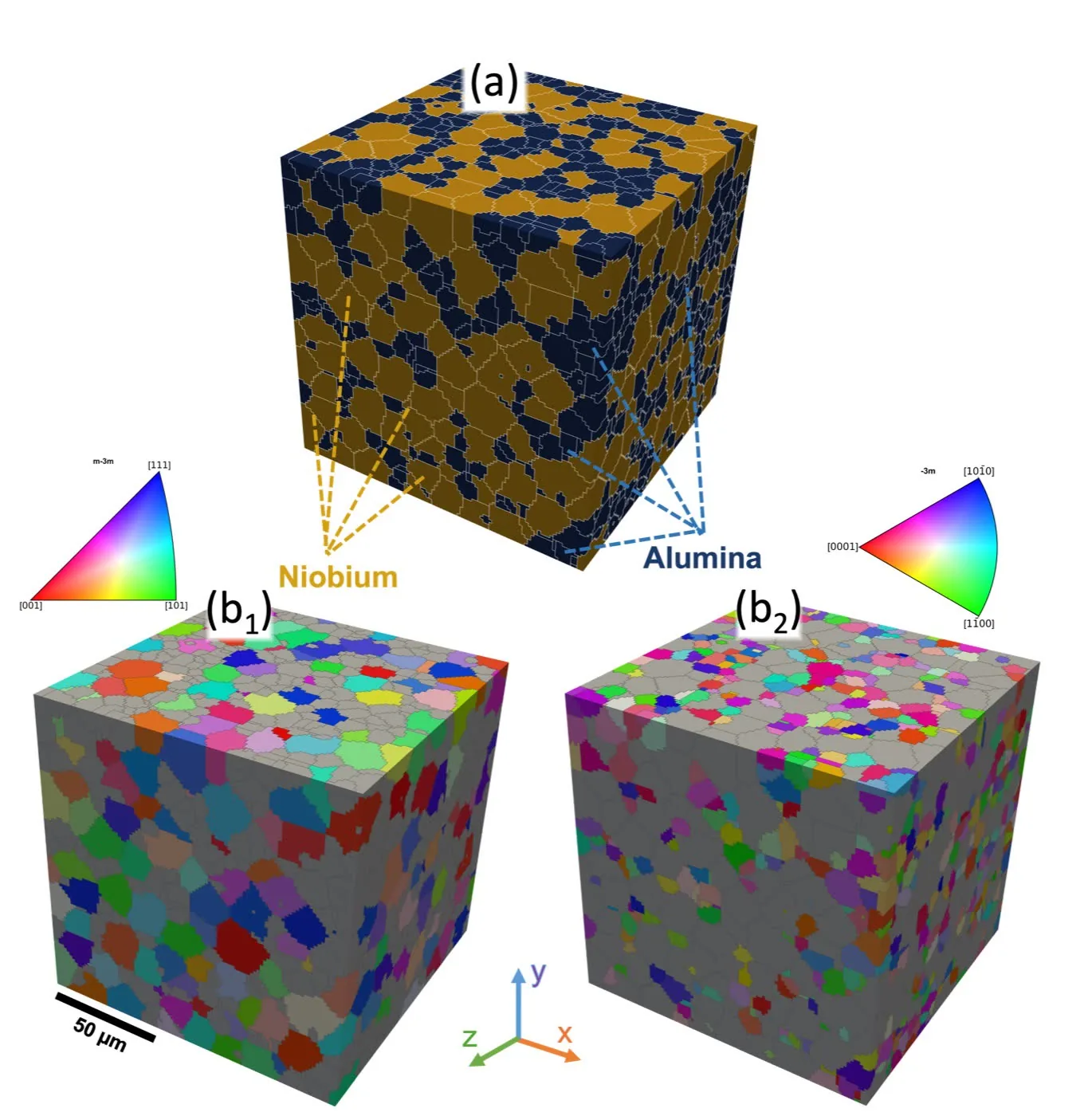
EBSD-to-simulation is my published workflow, not a service-page claim: the 2024 International Journal of Plasticity study I co-authored ran on exactly this chain — measured EBSD, MTEX texture analysis, and crystal plasticity models built on the real microstructure. My TRIP-steel composite work correlated EBSD with in-situ tensile testing and digital image processing to track where damage actually initiates. The analysis you get is the one my own papers depend on.
The same EBSD-to-model discipline underpins our 2026 Mechanics of Materials paper on LPBF AlSi10Mg tensile anisotropy, where measured orientation-dependent microstructure informed a 3D polycrystalline RVE and DAMASK simulations. That is the standard I apply to consulting work: EBSD is not decoration, it is the evidence chain.
Dr. Qayyum is a true brainstorming guru with an incredible depth of experience. He helped me develop a sophisticated analytical approach and a compelling visualization for a complex project that ultimately received high praise from my management team. — Abdelrahman Baraka, MSc Steel Technology, TU Bergakademie Freiberg, Germany
How it works
- 15-minute call. You describe the material, the measurement, and the question. If your data has a problem — indexing quality, coverage, resolution — I will tell you before you spend on analysis.
- Scoped engagement. A dataset review runs about a week; full analysis campaigns with texture, statistics, and simulation inputs typically 2–6 weeks. Agreed in writing first.
- Reproducible delivery. Results plus the scripts that made them — your group reruns and extends the analysis without me.
Common questions
Do you do the microscopy or just the analysis?
The analysis. You measure (or your facility does), I take the raw data from there. Where measurement strategy is the problem — step size, coverage, preparation — I advise before your next session so the new data answers the question.
My indexing quality is poor. Wasted measurement?
Often not. Preparation artifacts and pseudosymmetry are recoverable in post-processing; genuinely deformed fine-grained regions may need re-measurement. A short review of the raw data tells you which case you have — before you pay for microscope time.
Which software do you deliver in?
MTEX (MATLAB) for texture and grain analysis, Python for statistics and custom pipelines, and DAMASK-format outputs for simulation inputs. Everything scripted and commented — no black-box results.
Can you make the figures publication-ready?
Yes — pole figures, IPF maps, and ODF sections at journal quality, with the processing chain documented for your methods section. Reviewers increasingly ask how EBSD data was cleaned; you will have the answer in writing.
We want this capability in-house. Do you train teams?
Yes — MTEX workshops for research groups are a standard format, built around your own data rather than toy examples.
Can you prepare EBSD data for DAMASK?
Yes. I can convert cleaned and reconstructed EBSD data into direct or statistically matched inputs for DAMASK, with documented assumptions about grain morphology, texture, phase handling, and 2D-to-3D representation.
Start With 15 Minutes
Book a call and describe your data and your question. I will tell you honestly what the analysis can and cannot answer — and whether your measurement needs to be repeated before any analysis is worth paying for.
Book a 15-Minute Call Describe your situationRelated: Crystal plasticity simulation consulting · DAMASK crystal plasticity documentation and real workflows · How to publish DAMASK crystal plasticity research at the top of the field